Friday, February 4, 2022

Beyond The King: Scary Novels Not Written By Stephen King


Stephen King is arguably the greatest horror novelist in history, but horror is a big genre of literature, and there’s definitely other writers who can give you a scare fix beyond King. In the 80s, paperback horror was the top of the publishing industry, and that era and beyond has produced some great horror novels. Here are some other great titles to give you frights that will keep you turning pages.


Offseason By Jack Ketchum


Jack Ketchum, who passed away in 2018, was called the scariest writer in America, by Stephen King himself. That’s a great endorsement right there. He has written a lot of scary novels, but one of his most brutal is his 1980 novel “Offseason”, which like King, takes place in Maine. A couple of friends on vacation encounter a group of violent savages in a cave nearby their cabin, and battle for their lives against the cannibals. This book is a great horror novel, but not for the easily scared with it’s violent imagery. 


Demon Seed By Dean Koontz


Dean Koontz was the other major king of horror during Stephen King’s heyday, and is either regarded as another giant of the genre or just the Pepsi to Stephen King’s far superior Coke. However, Koontz has some scares up his sleeve too, and his 1977 novel “Demon Seed” is one of his most scary. What makes this novel so interesting is the horror is in a computer, as in, it’s an A.I. security system in a house that wants to entrap a woman  and do something to her. You keep guessing if it wants to kill her or is in love with her. However, what's so scary is the A.I. even narrates the book, so there’s no escape from the claustrophobic terror.


The Sun Down Motel By Simone St. James


The horror in this 2020 novel lies in the small details around a motel in upstate New York. The story goes back and forth between a current day paranormal writer, and her aunt from the 1980s, who might be stalked by a killer of women. However, the paranormal elements are there, and are horrifying. There are small and weird things about this seemingly normal motel. Something is not quite right about this motel, and the motel reminded me of a smaller scale version of the Overlook Hotel from Stephen King’s classic novel “The Shining”. This was one of the best novels I read last year, and is a scary page turner.


Interview With The Vampire By Anne Rice


Anne Rice’s classic 1976 horror novel is something of a throwback. It’s a gothic novel with more in common with Darcula, but still has a modern setting. Vampire Lestat bites Louis, and he becomes stuck in the horror of being forever young, and things only get worse as a little girl is bitten, and she is forever stuck at her young age. All in all, Louis tells his tale, to an interviewer, of the world he is stuck in, controlled by Lastat, living away from what should be the actual world they live in. It’s a thrilling and well written read, and a classic of the genre. Rice passed away this year, but her books still endure. 


These are some classics that will scare you up a storm. Yes, the real world is scary enough but who’s to say you can’t be scared in a fantasy world? At least it’s more entertaining. So dig up some of these classic horror novels, and go into one of the oldest literary genres. Stephen King might be the king of the genre, but even he would want you to explore other authors.

Monday, January 31, 2022

Roll Em: Great Books About Film


If you're like me, you are a big film buff. Film criticism is a whole form of writing on it’s own, and not simply an extension of film fandom, but a whole field. Lots of great books have been written by film critics and scholars, and stand on their own as books worth reading. Here are a couple titles that will take you into the world of movies.


The Great Movies By Roger Ebert

Roger Ebert is arguably the greatest film critic of all time. He is certainly the most popular of all time. The first film critic to win the Pulitzer Prize for criticism, in 1975, for his reviews for the Chicago Sun Times, he is even more well known for his long running TV show “Siskel & Ebert” where he sparred with fellow Chicago film critic Gene Siskel. He’s also written 20+ books, and while they are all worth reading, I think his 4 volumes of his Great Movies books are the most worth reading. In these books, he writes about everything from Charlie Chaplin’s “City Lights” to John Hughes’s “Planes, Trains and Automobiles” in his plain spoken but insightful way. It’s a good primer on the greatest movies to watch.

Hollywood Animal By Joe Eszterhas

Joe Eszterhas was the highest paid screenwriter in Hollywood in the 90s, and he came from the most unexpected place: a scuffy overweight serious journalist who fell into Hollywood legend out of nowhere. His scripts were either praised by critics (like “Music Box”) or derailed by critics but made a lot of money (like “Fatal Attraction”) or infamous for how bad they were (like “Showgirls”). However, his story is an interesting read, as he goes from a simple family life to having affairs, being an asshole (by his own admission) and dealing with sketchy Hollywood characters like producer Robert Evans.  It’s a glimpse into a bygone era of Hollywood, pre internet and streaming, where a guy like Eszterhas could write an idea on a napkin, and sell the napkin for a million dollars to a movie studio.

State Of The Art By Pauline Kael

Film critic Pauline Kael got her job after an editor saw her have a passionate fight over a movie in a restaurant. “State of the Art” is a collection of some of her best reviews. She talks about everything from “Superman” to “Sound of Music” in her witty, literate and interesting voice. Her career ranged from 1951 to her retirement in 1991, but in that time, she was considered one of the most important film critics of her era, and was regularly cited by Roger Ebert as a great teacher of the form of writing criticism.

Mike, Spike, Slackers & Dykes By John Pierson

Filmmaker John Pierson presents a history of the independent film movement from the late 80s to throughout the 90s, when studios like Marimax (and sadly, we have to mention the head of that studio, the Weinsteins), were scooping up the counterculture films, and changing filmmaking forever. Off the era of corporate filmmaking of the 80s, Pierson presents a history of the independent film movement through the lens of Spike Lee, Kevin Smith and Michael Moore as they turn the type of films in the mainstream on its head, by simply entering it. 

So, these are some great books on film worth reading. Film is an interesting medium, and worth digging into than simply watching. Film criticism and studies is a genre worth reading, even if you never want to pick up a camera yourself. Being a film buff is enough sometimes.

Sunday, January 23, 2022

Just Because It's Cancelled On TV, Doesn't Mean The Books Are


Something that often happens is a TV show will live on, either in book or comic book form, after it’s cancelled or reached it’s natural conclusion on TV. Here are some examples of your favorite TV series continuing as book series, and some of them are so retro, they might surprise you.


Star Trek

“Star Trek” is the most famous TV show to be adapted to print, and the most long running. Covering every single series, from the original “Star Trek” to “Star Trek: Discovery”, to even an alternative version of “Star Trek” universe novels written by William Shanter, called the “Shanterverse”, the books have been in print since 1967, and has over 850+ novels, selling millions of copies. Notable writers who have written books include Peter David and Diane Duane.


Buffy The Vampire Slayer/Angel

“Buffy The Vampire Slayer” and it’s spin off “Angel” still have novels published to this day, mainly in paperback. One of the things fans like about the “Buffy” novels is they tell you what seasons of the show the novels take place in, so you get details during the actual course of the series you might have missed or simply didn’t see in the main story. Then there’s the Angel novels, which continue the series from the series finale, and have plenty of crossovers between the Buffy series, as they are both created by Joss Wheadon. 


Monk

Everyone’s favorite OCD detective had plenty of novels after the TV series concluded.The novels seemed to have stopped being published in 2015, but despite that, if you didn’t know about them, they should still give you plenty of a Monk fix, as there are over 19 books in the series. Some are 3rd person, and some are narrated by either one of Monk’s assistants, Sharona or Natalie.


Murder She Wrote

If you want to go all the way back, they still publish Murder She Wrote novels to this day. Everyone’s favorite mystery writer and sleuth, Jessica Fletcher, might not be solving crimes on TV anymore, but is still solving crimes in books. The novels have been coming out with new ones since 1985, with the newest ones slated to come out next year. I don’t have an exact number of how many books there are, but 55 more have come out since 2000, with 2 more to be published in 2022.


Hopefully, this will give you a fix for good books based on your favorite TV shows, and you can go on some new adventures with your favorite characters instead of simply reruns.


Sunday, January 2, 2022

"The Other Emily" Isn't Bad But Builds Up To A Loose End

I’m a big fan of Dean Koontz, who I think is unfairly compared to Stephen King, despite totally understanding the comparison. King was the king of the market Koontz wrote for, back in the 1980s and 1990s, when the horror paperback novel was the king of mass publishing. If King was the Coke of horror, Koontz became known as the Pepsi of the genre. The funny thing is, Koontz has actually quietly sold more copies than King has, but due to the iconicness of King’s creations, King is better known then Koontz. I’ve been reading King and Koontz for a ton of years, though, and I think they both have their charms. King is able to convey pure evil, while Koontz is able to portray good triumphing over it. If King is rock and roll in book form, Koontz is Christian rock in book form, and I’m actually fine with both of these things.


So Koontz’s latest novel “The Other Emily” was a Kindle deal on Amazon, and I picked it up. The story is about a 30 something guy named David Throne, who is obsessed with the disappearance of a girlfriend from 10 years ago named Emily. She went out one night and never came back. He is also a successful author, so he has considerable wealth, and also funds the life of a murderer named Ronald Lee Jessup in prison, a sweet seeming man who killed 27 women, kidnaping them and playing games with them in a basement, until he would murder them. He visits him in prison, under the false pretense of writing a book about him. He visits him monthly, trying to get an answer about his girlfriend, who he thinks might be one of his victims. Thorne’s life goes off the rails, when he meets a woman named Madison, who is a dead ringer for his disappeared girlfriend, and they end up having a relationship.


This book shows both the best and worst Koontz is able to do. One of the things Koontz is best at is piling on events, more and more, making things get more weird and suspenseful. Koontz is primarily known as a horror writer, but he’s great at weaving tons of genres into a narrative that doesn’t seem all over the place. Koontz’s novels follow a very straight line, as opposed to King, who often gets into bloat, and has a subplot or two which seem to just serve to make a book longer. I love King, but damn, when I was reading “It”, I often forgot there was even a clown in the book, due to 100+ pages of the personal problems of the victims of Pennywise. Koontz has these things too, as Thorne has plenty of problems that aren’t a part of the main plot, but the length of his books are often more manageable. 


However, a common problem of Koontz novels is he builds himself up to a reveal, and a lot of times, they don’t pay off. This is another book where the end has a reveal, but cuts it there, and just sorta ends. I was on board throughout the entire novel, asking myself if this is a science fiction twist of some sort, like “Blade Runner” or some supernatural thing. Was Emily and Madison a robot or clone? Her mother was blind. Was she even her baby? Koontz keeps raising the stakes, but I was a bit confused at the end, and this novel would have benefited greatly with a year later epilogue. I wanted to know if Madison and David somehow made this work or considering the overarching problem of where Madison came from, this fell apart somehow? Either way, I enjoyed the novel but wish the ending answered my question a bit better. Koontz is a master storyteller but his endings still often leave a lot to be desired.


Monday, December 20, 2021

Anne Rice's Ultiment Horror Was Being A Outcast


Last week,  Anne Rice died and the in a lot of ways,  we lost more than simply a great storyteller who sold a ton of copies. We also lost the anti-J.K. Rowling. Let me explain. While Rowling’s politics are mostly progressive, and it’s shown in her public support for American Democrats, her now ironic themes of inclusion in her Harry Potter novels,  and like Rice, her embrace of the fantastical to represent the outcast. For Rowling, it was mainly nerdy kids looking for a group to belong to, which in this case was a wizard school of kids who are basically chosen ones. With Anne Rice, it was adults, who felt shunned out sexually, socially, and emotionally, but more a group of cursed ones than chosen ones. Anne Rice’s books were extremely popular with LGBT readers, and until her death, she was a champion of those who are gay, bi, or trans. Rowling on the other hand, has tarnished her goodwill by coming out against trans people.

Rice, though, never lost sight of the outcast as the main focus of her writing. In her first novel, “Interview with The Vampire”, we are introduced to Louis, who becomes a outcast after being bitten by Lestat.  He becomes something of his husband, and not only that, they find a bitten young girl, and end up raising a daughter together. Lets not forget, this novel was way ahead of it’s time, being published in 1976. Complete with no chapter breaks, it’s a bewitching horror novel, and stands out in other ways as well. Rice’s writing is lush, and unlike King, Koontz or other writers of this time period, has a very Victorian novel sounding proses. Her writing is closer to Austen than Lovecraft.

Lastat is a complicated character,  who appears on and off throughout the rest of Rice’s “Vampire Chronicles” novels, and in my opinion, is one of the great literary creations of the second half of the 20th century. He is both good and bad, a  hero and anti-hero, and at one point, even becomes quite literally a rock star. In one of her last novel, “The Prince Lastat”, his bloodline gets connected to every vampire in the world, where if he dies, they all die. He is the center of all the vampires in the  world, and also the center of Anne Rice’s novels.

Anne Rice’s novels are a great read, and vampires aren’t all she wrote. She also wrote historical novels and she wrote erotic novels under a pen name. She also wrote novels about Jesus, werewolves and angels.

Rice had a complicated relationship with the Catholic Church, leaving it over her son coming out of the closet and their stance on women’s rights. The main theme of Rice’s work, I always felt, is not fitting in, as a whole, and that is what made her novels so interesting. Her vampires where sexy, but in a mysterious outcast way, and not a sparkling Twilight way. Vampires have that curse of immortal youth, we would all like, but often find when they have it, it’s quite a curse. Rice understood this better than anyone.


Thursday, November 25, 2021

"Plum Island" Is A Fun Guy Fantasy, But Way Too Long


After 20 or so years, Nelson DeMille is coming out with a squeal to this novel, titled "The Maze" in 2022. So here's my review of his 1997 novel "Plum Island" which introduced his most famous character, John Corey

I really like Nelson Demille and his John Corey novels. John Corey is a really good character, one of those lovable old-fashioned guys who talk tough and sees women as objectable figures, but also can work with one without problem, and seems he would never commit anything more than some stupid comments towards them. However, when it comes to the bad guys, Corey has no problem going after them.

 This is the first novel featuring DeMille's signature character, and the mystery reads differently today than it did in 1997. Basically, two friends of Corey, Tom and Judy Gordon turn up dead. It's unclear why exactly  this young yuppie Long Island couple would befriend an old, right-wing guy like Corey. The explanation isn't great. He hit on the wife at a bar, and instead of walking out in disgust, the husband and wife are charmed and befriend him? Er. Sometimes DeMille's book reads a bit like an old-fashioned, conservative fantasy world, which is unrealistic, even for the mid-90s way before woke culture and the MeToo movement. However, the plot is they are murdered, and at first, there's suspicion that they were trying to sell chemicals to create a mass virus that infects America then they could become rich selling the cure to it. That's the part that reads differently today. However, there's a twist that their murder actually has to do with lost treasure buried on Long Island. Corey makes a ton of cracks and says some stupid things. His love of the death penalty, even for a right-winger, comes off more creepy than conservative un-PC humor. However, I like Corey and I like the writing of DeMille. 

He is the middle-aged guy's Nicholas Sparks, as in the total opposite of Sparks but read by middle-aged guys for the same reason women read Sparks. It's a male-centric fantasy where every attractive younger woman wants to sleep with an overweight, old-school, and much older former cop on Long Island. Also, this old-school former cop breaks a ton of rules to catch a killer, then simply walks away with a quiet deal to go on with his life. Corey is the opposite of every male character Sparks ever wrote but is read for the same reason women read about men in Sparks characters.  He's a fantasy figure in a fantasy world where everyone is having an instant-made relationship for not a ton of reasoning. 

The main problem with this book, and a lot of DeMille's books, is they really need an editor. I mean this was almost 600 pages, and this being a pretty basic mystery, THAT IS WAY TOO LONG. By the end, you do want this guy to wrap it up, and he doesn't. This isn't a Stephen King or fantasy novel or some historical novel that needs a ton of explanation or world-building. I grew up on Long Island. I get it. Even if you never been to Long Island, it's not that hard to figure out. I was torn between three and four stars, while not ever thinking five. However DeMille has a whatever, it's all great and cranky charm I like and you don't see much in thriller writers anymore. However, because his book was so weirdly long to the point it became torture by the end, it is bumped down to three stars.


Tuesday, November 2, 2021

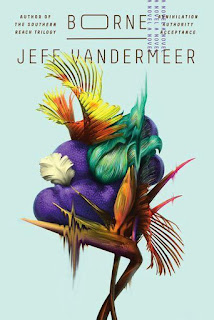
“Borne” Is An Insanely Solid Work Of Weird Fiction

Weird fiction as a genre can go so many ways. It can be just plain weird, in a way you aren’t really sure what you just read, but are glad you have read something different. It can be weird in a reflective way, in a way that it lets you look at something in real life in a different way. Then it can make you feel for something so weird, you are surprised you felt emotions for it. “Borne” by Jeff VanderMeer falls into the third category. It’s a very, very solid piece of weird fiction, and I was surprised how good it was, possibly going up to number one in my end of the year wrap up of the best things I read this year.

“Borne” is about a woman named Rachel, who makes her living as a scavenger, in a dystopian city which is overlooked by a giant bear named Mord. The giant bear was by mistake created by a biotech company, now has taken over and is a constant threat to the people who live in the city. This is one of those dystopian futures, with scant details, which is more acceptable in weird science fiction then traditional science fiction. Traditional science fiction with a dystopian theme would have pages and pages of information concerning world building, giving us details, names, dates, and backstories. Weird fiction, because it’s well, weird, can skip over all that. We don’t know the name of the company. We don’t exactly know the time line of the novel’s world either. Rachel, as the narrator, dives into her back story, but most if it is a happy childhood we know will end at some point due to the world turning into a dystopian one at some point. She lives with her boyfriend, named Wick, and on her journey, finds a shape shifting furry technological mess she names Borne.

Throughout the novel, she starts to care deeply for Borne, despite Wick wanting to destroy him. She starts to consider herself a single mother. She becomes emotionally attached, and ironically, Borne is lovable in his simplicity. I found myself feeling some deeper emotions for these characters than I have for some of the more traditional and human characters I have read recently. Jeff VanderMeer also writes a believable female voice in Rachel, so bravo for that, because a lot of male writers stink at writing women, much more in their own narrative voices. I felt a lot of compassion for everyone in this novel. Despite a lot of vagueness on purpose, I didn’t find this novel overly hard to follow, either. Sometimes it’s hard to follow weird fiction as a story, but this novel didn’t have that problem.

“Borne” is brilliant, bizarre and mesmerizing. It’s well worth the read.  Jeff VanderMeer is a very, very solid writer and this is a very, very solid piece of weird fiction.


"The Secrets of Secrets" Doesn't Add Up